ibn sultan
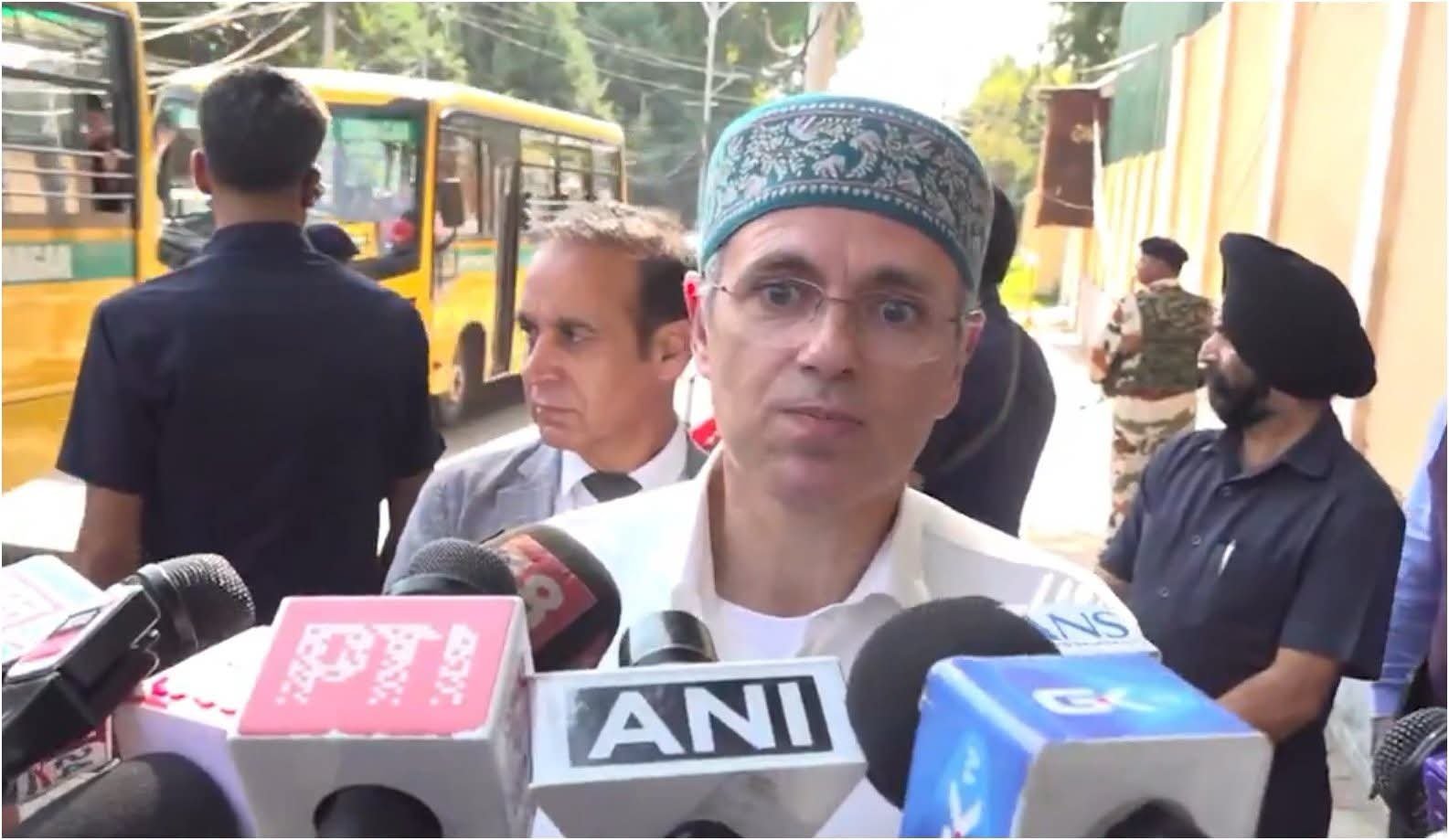
Jammu and Kashmir Chief Minister Omar Abdullah has written to the presidents of 42 political parties, including Congress chief Mallikarjun Kharge, urging them to press the Centre to bring legislation in the ongoing Parliament session to restore statehood to Jammu and Kashmir.
Officials said on Tuesday that the National Conference leader has said that restoring statehood must not be viewed as a concession but as an essential course correction.
– ‘still optimistic’
Abdullah termed it as an issue that goes beyond regional interests and touches the very core of the country’s Constitutional values and democratic ethos, officials were quoted by the news agency PTI
Abdullah said that downgrading a state to a Union Territory sets a “profound and unsettling” precedent and is a “constitutional red line” that “must never be crossed”.
“The act of reducing Jammu and Kashmir from a state to a Union territory in 2019 and the prolonged delay in restoring its status as a full state… has profound implications for the future of Indian polity,” the three-page letter written on July 29 said.
On Monday, Abdullah said he is optimistic about ‘something positive’ for the Union Territory during the ongoing parliament session, but not on Tuesday, amid buzz over the centre planning something on Jammu and Kashmir’s ‘statehood’.
Abdullah’s remarks came on the eve of August 5, the sixth anniversary of Article 370’s abrogation. Abdullah clarified that he had no meeting or conversation with the people in Delhi and that his statement was based on his “gut feeling.”
Speculation about ‘something’ happening
The speculation about ‘something’ happening on August 5 was fuelled by the government’s reported meetings on Monday. Though there was no official word on any meetings, some reports suggested Union Home Minister Amit Shah met with National Security Advisor Ajit Doval, Intelligence Bureau chief Tapan Kumar Deka, and Home Secretary Govind Mohan on Monday.
In the letter, the chief minister said the reorganisation of Jammu and Kashmir into a Union Territory in August 2019 was presented as a “temporary and transitional measure” and cited repeated public assurances from Prime Minister Narendra Modi, including a promise made in Kashmir earlier this year that he called “Modi ka Wada.”
Abdullah also cited the Centre’s stand before the Supreme Court, reaffirming its commitment to restore statehood as soon as possible. He argued that the “interpretation of terms like ‘at the earliest’ or ‘as soon as possible’ cannot stretch into years or decades.
The erstwhile state of Jammu and Kashmir was reorganised into the Union territories of Jammu and Kashmir and Ladakh following the abrogation of Article 370 on August 5, 2019. Tuesday was the sixth anniversary of the decision. Incidentally, the Parliament’s Monsoon session is also on.
The people of Jammu and Kashmir have already waited long enough—statehood must be restored now, Abdullah said. According to the letter, Abdullah argued that the moral premise behind the removal of Article 370 was based on the “argument of equality,” but that this principle has not been applied equally.
“The denial of statehood is not something that has been imposed on any other region in India; in fact, the historical trajectory has always been from Union Territory to State, not the reverse,” the letter said.
Abdullah urged the political parties to press the Centre to bringin legislation in the current session of Parliament to restore the statehood in Jammu and Kashmir.
“The restoration must not be viewed as a concession, but as an essential course correction —one that prevents us from sliding down a dangerous and slippery slope where the statehood of our constituent states is no longer regarded as a foundational and sacred constitutional right but reduced instead to a discretionary favour bestowed at the will of the Central Government,” the letter said.
The chief minister said anything less would undermine the very idea of India and a departure from the vision of the founding fathers who framed a Constitution rooted in federalism, dignity and democratic self-governance.
‘Lamhon ne khata ki thi, sadiyon ne saza payi’
The chief minister’s letter warned that the “temporary” status is beginning to “appear more as a convenient alibi than a genuine commitment,” serving as a “proverbial fig leaf” for an “indefensible act”.
Abdullah said that the six-year persistence of this status is “far beyond what any reasonable interpretation of the word might allow” and that an arrangement “meant to be transitional cannot be allowed to harden into permanence”.
Abdullah pointed to two recent events as “extraordinary opportunities to heal historical wounds and reinforce national unity”: the high voter turnout in the recent elections and the public condemnation of terror following an incident at Pahalgam.
The restoration must not be viewed as a concession, but as an essential course correction.
“To allow such moments to pass – unacknowledged or unreciprocated due to narrow partisan calculations, will, without doubt, be a monumental mistake,” the chief minister cautioned and quoted famous poet Muzaffar Razmi Kairanavi: “Lamhon ne khata ki thi, sadiyon ne saza payi (Moments committed the mistake, centuries got the punishment)”.(PTI)